


Why Car Dealerships Need CRM and Accounting in One Integrated System
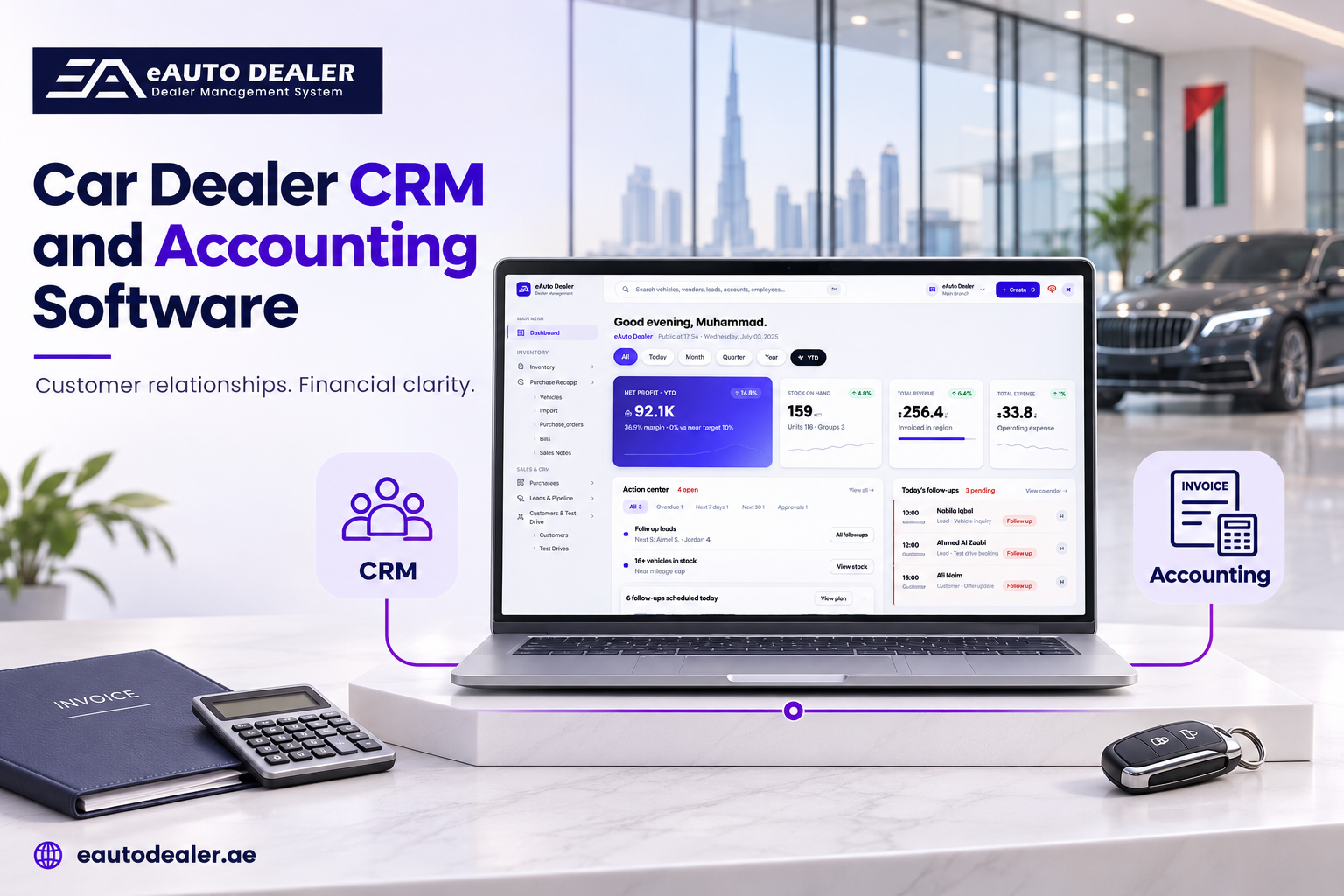
Running a car dealership involves more than selling vehicles and maintaining customer records. Sales teams handle enquiries, arrange vehicle viewings, prepare quotations, and follow up with potential buyers, while accounting teams manage invoices, payments, expenses, and financial records. When these activities are handled through separate systems, important information can become disconnected, creating extra work and communication gaps.
An integrated Car Dealer CRM and Accounting Software brings customer management and financial operations closer together, helping dealerships maintain better visibility from the first enquiry to the completed transaction. For car dealers, this connection can support more organized sales processes, accurate financial records, and smoother coordination between departments.
What Is an Integrated CRM and Accounting System?
An integrated CRM and accounting system connects two important business functions: customer relationship management and financial management.
CRM helps a dealership manage customer information, enquiries, sales opportunities, communication history, and follow-ups. Accounting handles financial activities such as invoices, payments, expenses, outstanding balances, and financial reporting.
When both functions operate within one connected platform, relevant information can move between sales and accounts workflows instead of being maintained in separate records.
For example, when a sales representative completes a vehicle sale, the transaction information can be made available to the accounting process, depending on the system's configuration. This reduces the need to repeatedly enter the same details and helps employees work with more consistent records.
A combined solution may include:
-
Customer and lead management
-
Sales pipeline tracking
-
Customer communication history
-
Quotations and sales records
-
Invoice and payment management
-
Expense and financial records
-
Outstanding balance tracking
-
Sales and accounting reports
-
Customer purchase history
Why Are CRM and Accounting Both Important for Car Dealerships?
CRM and accounting serve different purposes, but they are closely connected in dealership operations.
A CRM system helps sales teams understand customers and manage opportunities. Accounting helps the business understand the financial side of those transactions.
Consider a customer who contacts a dealership about a used vehicle. The sales representative records the enquiry, discusses the customer's requirements, arranges a viewing, and prepares a quotation. If the customer decides to purchase, the dealership must also manage the invoice, payment, vehicle sale, and relevant financial records.
If CRM and accounting work separately, employees may need to transfer information manually. When both are integrated, the dealership can create a more connected process between customer management and financial activities.
8 Reasons Car Dealerships Need CRM and Accounting in One System
1. Complete Visibility from Customer Enquiry to Final Payment
A vehicle sale does not begin when an invoice is created. It starts with a customer enquiry and moves through discussions, negotiations, quotations, and purchase decisions.
When CRM and accounting are connected, authorized employees can access relevant information throughout the customer journey.
Sales teams can manage enquiries and opportunities, while accounts employees can review the financial details associated with completed transactions. This gives the dealership a clearer view of how customer activity connects with business revenue.
2. Reduced Duplicate Data Entry
When CRM and accounting use separate databases, employees may need to enter the same customer details multiple times.
For example, a sales representative may record a buyer's name, contact number, and vehicle requirement in CRM. Later, an accounts employee may enter the same customer information again while preparing an invoice.
Repeated data entry takes time and can lead to spelling mistakes, incorrect contact details, or inconsistent records.
An integrated system can reuse relevant customer and transaction information across connected functions, reducing unnecessary manual work.
3. Better Coordination Between Sales and Accounts Teams
Sales and accounting departments depend on information from each other. Sales employees need to know whether payments have been received, while accounts employees need accurate transaction details to maintain financial records.
When both departments work with disconnected systems, they may rely on calls, emails, or spreadsheets to exchange updates.
An integrated platform helps create a shared workflow where relevant information is easier to access. This can reduce communication gaps and make responsibilities clearer.
4. More Organized Invoice and Payment Management
Vehicle sales involve financial transactions that need to be recorded properly. Depending on the dealership's process, employees may need to manage quotations, invoices, deposits, partial payments, and outstanding balances.
When accounting is connected with sales records, relevant transaction details can be linked with customer information.
This helps dealerships:
-
Maintain organized customer invoices
-
Record payments against relevant transactions
-
Monitor outstanding balances
-
Review payment history
-
Track financial details associated with vehicle sales
The exact capabilities depend on the accounting functions provided by the software.
5. Clearer Customer Purchase and Payment History
Understanding a customer's previous interactions can help dealerships provide better service.
CRM maintains information such as enquiries, communication history, preferences, and previous sales opportunities. Accounting records provide the financial side, including invoices and payments.
When these records are connected, authorized employees can get a more complete view of the customer relationship.
For example, when a returning customer contacts the dealership, staff may be able to review previous vehicle purchases and relevant financial records without searching through separate files.
6. Improved Sales and Financial Reporting
Dealership owners need to understand both sales performance and financial results.
CRM reports can help measure enquiries, lead conversion, follow-up activity, and sales opportunities. Accounting reports can provide information about revenue, expenses, payments, and outstanding amounts.
An integrated system can make it easier to compare relevant operational and financial information.
Useful reports may include:
-
Sales revenue by period
-
Vehicle sales performance
-
Customer enquiry conversion
-
Outstanding customer balances
-
Payment collection status
-
Business expenses
-
Profitability information, where supported
-
Sales activity by employee or branch
These reports help management identify performance gaps and make more informed decisions.
7. Better Management of Vehicle Sales Costs
A dealership's financial performance depends on more than the final selling price of a vehicle. Purchase costs and other associated expenses can affect the amount earned from each sale.
For example, a used vehicle may involve a purchase price, transportation expenses, repairs, inspection costs, and other preparation charges.
When vehicle and financial records are connected, dealerships can maintain better visibility into relevant costs and sales transactions. This can support more informed decisions about pricing and profitability, provided the system captures the necessary cost information.
8. More Consistent Operations as the Dealership Grows
As a dealership expands, the number of customers, vehicles, transactions, and employees usually increases. Managing CRM and accounting separately can create additional administrative work.
An integrated solution provides a more structured way to maintain customer and financial information. Depending on its capabilities, it may also support multiple users, branches, and consolidated reporting.
This helps dealerships build processes that can accommodate growing operational requirements.
What Happens When CRM and Accounting Are Managed Separately?
Using separate systems is not always a problem, but it can create difficulties when information needs to move between departments regularly.
|
Business Activity |
Separate CRM and Accounting |
Integrated CRM and Accounting |
|
Customer information |
May be entered in both systems |
Shared relevant customer records |
|
Sales transactions |
Details may need manual transfer |
Connected sales and financial workflows |
|
Invoicing |
Information may need to be re-entered |
Can use available sales and customer details |
|
Payment updates |
Separate updates may be required |
Relevant financial information can be linked |
|
Customer history |
Spread across different records |
More connected customer information |
|
Reporting |
Data may need to be combined |
Easier access to relevant reports |
|
Team coordination |
Depends on manual communication |
Shared workflows and information access |
The biggest advantage of integration is the connection between activities. Instead of treating customer management and accounting as unrelated tasks, dealerships can manage them as parts of the same business process.
How an Integrated System Supports the Complete Car Sales Process
To understand the practical value of integration, consider how a typical vehicle sale can move through a dealership.
Step 1: A Customer Enquiry Is Recorded
A potential buyer contacts the dealership through its website, phone, social media, or showroom. The sales representative records the customer's details and vehicle requirements in CRM.
Step 2: The Sales Team Manages the Opportunity
The representative follows up with the customer, shares relevant vehicle information, arranges a viewing, and discusses pricing. The enquiry moves through the dealership's sales process.
Step 3: A Quotation Is Prepared
When the customer shows interest, the sales team prepares a quotation or records the agreed sales details. The relevant information remains connected with the customer record.
Step 4: The Sale Moves to Accounting
Once the transaction progresses, the relevant sales details can be used within the accounting workflow, depending on the system's integration and configuration.
Step 5: Invoice and Payment Records Are Maintained
The accounts team manages the invoice and records payments according to the dealership's process. Outstanding amounts can also be monitored where the system supports this functionality.
Step 6: Management Reviews the Results
Sales and accounting reports help management review the transaction and understand its contribution to overall business performance.
This connected process can reduce repeated data entry and provide better visibility across departments.
Why Integration Matters for UAE Car Dealerships
Car dealerships in the UAE may manage locally purchased vehicles, imported stock, multiple showrooms, and customers with different purchasing requirements. These operations involve both customer-facing activities and financial responsibilities.
An integrated CRM and accounting platform can help businesses organize these activities more consistently.
Managing Local and International Customers
Dealerships may receive enquiries from local buyers as well as customers from other countries. Maintaining customer details, communication history, quotations, and transaction records in an organized system can make these interactions easier to manage.
Handling Vehicle Purchases and Sales
Vehicle acquisition costs and sales transactions are connected. When relevant purchasing, inventory, sales, and accounting records are linked, dealerships can maintain better visibility into the financial side of their vehicle operations.
Supporting Accounting and Tax Requirements
Businesses operating in the UAE need to maintain appropriate accounting records and follow applicable tax and invoicing requirements. Before choosing a system, dealerships should verify that its accounting features support their specific requirements, including relevant VAT processes where applicable.
Managing Multiple Branches
Dealerships with more than one showroom may need to monitor customer enquiries, sales transactions, and financial performance across locations. A platform with suitable multi-branch functionality can help management review relevant information centrally.
Essential Features to Look for in an Integrated CRM and Accounting Solution
Not every platform offers the same level of integration. Some systems provide separate CRM and accounting modules, while others connect specific workflows more closely.
Before selecting a solution, car dealerships should review the following features.
Customer and Lead Management
The CRM should allow employees to create customer profiles, record enquiries, assign leads, maintain communication history, and track sales opportunities.
Sales Pipeline Management
Look for a system that allows teams to monitor each opportunity from initial enquiry to completed sale. Customizable sales stages can help dealerships follow their own process.
Quotation and Invoice Management
The platform should support the preparation and management of quotations and invoices, with relevant customer and transaction information available to authorized employees.
Payment Tracking
Check whether the system can record payments, monitor outstanding amounts, and maintain transaction histories.
Financial Reporting
Accounting features should help dealerships review revenue, expenses, payments, and other important financial information.
Vehicle Inventory Integration
For automotive businesses, CRM and accounting become more useful when they can work with vehicle inventory information. This helps connect customer interest, vehicle availability, sales, and related costs.
User Roles and Data Security
Sales representatives, accountants, and managers may require different levels of access. Review user permissions, backup arrangements, and data protection practices before implementation.
UAE Accounting Requirements
Confirm whether the accounting module supports the dealership's applicable invoicing, VAT, and financial record-keeping requirements. Do not assume every platform provides the same compliance features.
How to Choose the Right Integrated System for Your Dealership
Selecting software should begin with an understanding of how your dealership currently operates.
1. Review your existing processes: Identify how customer enquiries, quotations, vehicle sales, invoices, and payments are managed.
2. Identify information gaps: Find out where employees enter the same information repeatedly or struggle to access important records.
3. Check the level of integration: Ask how customer details, sales transactions, and accounting records move between modules. Do not rely only on the word "integrated" in a product description.
4. Evaluate automotive-specific features: A dealership has different requirements from a general retail business. Review vehicle inventory, purchase management, and sales workflows.
5. Examine reporting capabilities: Make sure managers can access the sales and financial information they need.
6. Consider usability and training: Employees should be able to understand the system and complete daily tasks without unnecessary complexity.
7. Review support and scalability: Check implementation assistance, data migration, customer support, and the ability to accommodate future business growth.
A practical demonstration is particularly useful. Ask the provider to show how a customer inquiry moves through the sales process and how the resulting transaction connects with accounting.
How eAuto Dealer Connects Dealership Sales and Financial Operations
For automotive businesses, CRM and accounting are closely related to other dealership activities, including vehicle inventory, purchasing, and sales management.
eAuto Dealer offers a dealership management solution with relevant functions for organizing areas such as sales and CRM, accounting and finance, inventory, purchasing, and reporting.
By managing these activities through a connected dealership platform, businesses can reduce dependence on separate records and improve visibility across their operations. Sales teams can focus on customer enquiries and opportunities, while accounts employees can manage the relevant financial information within the dealership's workflow.
For dealerships considering an integrated solution, it is important to review how the available eAuto Dealer modules support their specific sales and accounting processes, reporting needs, and branch requirements.
Common Mistakes to Avoid When Integrating CRM and Accounting
Integration can improve business organization, but the results depend on selecting and implementing the system properly.
Avoid these common mistakes:
-
Choosing software without checking integration: Confirm how CRM and accounting exchange relevant information.
-
Maintaining duplicate customer records: Establish a consistent process for creating and updating customer profiles.
-
Ignoring sales-to-accounting workflows: Test how completed sales, invoices, and payments are handled.
-
Overlooking employee training: Make sure sales and accounts teams understand their respective responsibilities.
-
Not reviewing financial data: Check existing customer balances, invoices, and transaction records before migration.
-
Ignoring reporting requirements: Identify which sales and financial reports managers need regularly.
-
Assuming all UAE requirements are covered: Verify the system's accounting and tax capabilities against your business obligations.
Final Thoughts
CRM and accounting are two essential parts of car dealership management. CRM helps businesses organize customer relationships and sales opportunities, while accounting provides visibility into invoices, payments, expenses, and financial performance. When these functions operate separately, employees may spend extra time transferring information and resolving inconsistencies.
An integrated CRM and Accounting System connects customer management with financial operations, creating a more organized process from the first enquiry to the completed sale. For UAE car dealerships, choosing a solution that also works with inventory, purchasing, and reporting can provide a clearer view of daily operations. The most suitable system is one that supports the dealership's actual workflow, reduces unnecessary manual work, and can adapt as the business grows.
Frequently Asked Questions (FAQs)
1. Why do car dealerships need CRM and accounting in one system?
Car dealerships need CRM and accounting together because customer enquiries, sales transactions, invoices, and payments are connected. Integration helps reduce repeated data entry and provides better visibility across sales and financial activities.
2. What is the difference between CRM and accounting software?
CRM software manages customer information, enquiries, communication, and sales opportunities. Accounting software manages financial records such as invoices, payments, expenses, and reports. An integrated system connects relevant information between these functions.
3. How does integrated CRM and accounting software help car dealers?
It helps car dealers organize customer records, manage sales opportunities, connect transactions with financial records, reduce manual updates, and review business performance more easily.
4. Can CRM and accounting software track vehicle sales?
A dealership solution with connected sales and accounting functions can help track relevant vehicle sales information and associate transactions with customer and financial records. The exact capabilities depend on the platform.
5. Does an integrated system reduce duplicate data entry?
Yes. When modules share relevant customer and transaction information, employees may not need to enter the same details separately. The amount of automation depends on how the system is configured.
6. Can an integrated system manage invoices and customer payments?
Many integrated solutions include invoicing and payment management features. Dealerships should check whether the selected system supports their required invoice formats, payment records, and outstanding balance tracking.
7. Is integrated CRM and accounting software suitable for small dealerships?
Yes. Small dealerships can benefit from connected customer and financial records, particularly when they want to establish organized processes as the business grows. They should choose a system that matches their current requirements.
8. What should UAE car dealers check in accounting software?
UAE car dealers should review invoice management, financial reporting, payment tracking, applicable VAT support, data security, and compatibility with their accounting processes. They should verify compliance-related capabilities with the provider and their accounting professional.
9. Can CRM and accounting work with vehicle inventory management?
Some dealership management systems connect CRM and accounting with vehicle inventory. This can help link customer enquiries, vehicle availability, sales transactions, and relevant financial records.
10. How can a dealership choose the right integrated CRM and accounting system?
A dealership should evaluate its sales process, accounting requirements, inventory integration, reporting needs, usability, security, training, and customer support. A practical demonstration can help confirm whether the system connects CRM and accounting in the way the business requires.
 Italiano
 English
 Arabic
 French
 Spanish
 Portuguese
 Deutsch
 Turkish
 Dutch
 Russian
 Romaian
 Portuguese (Brazil)
 Greek