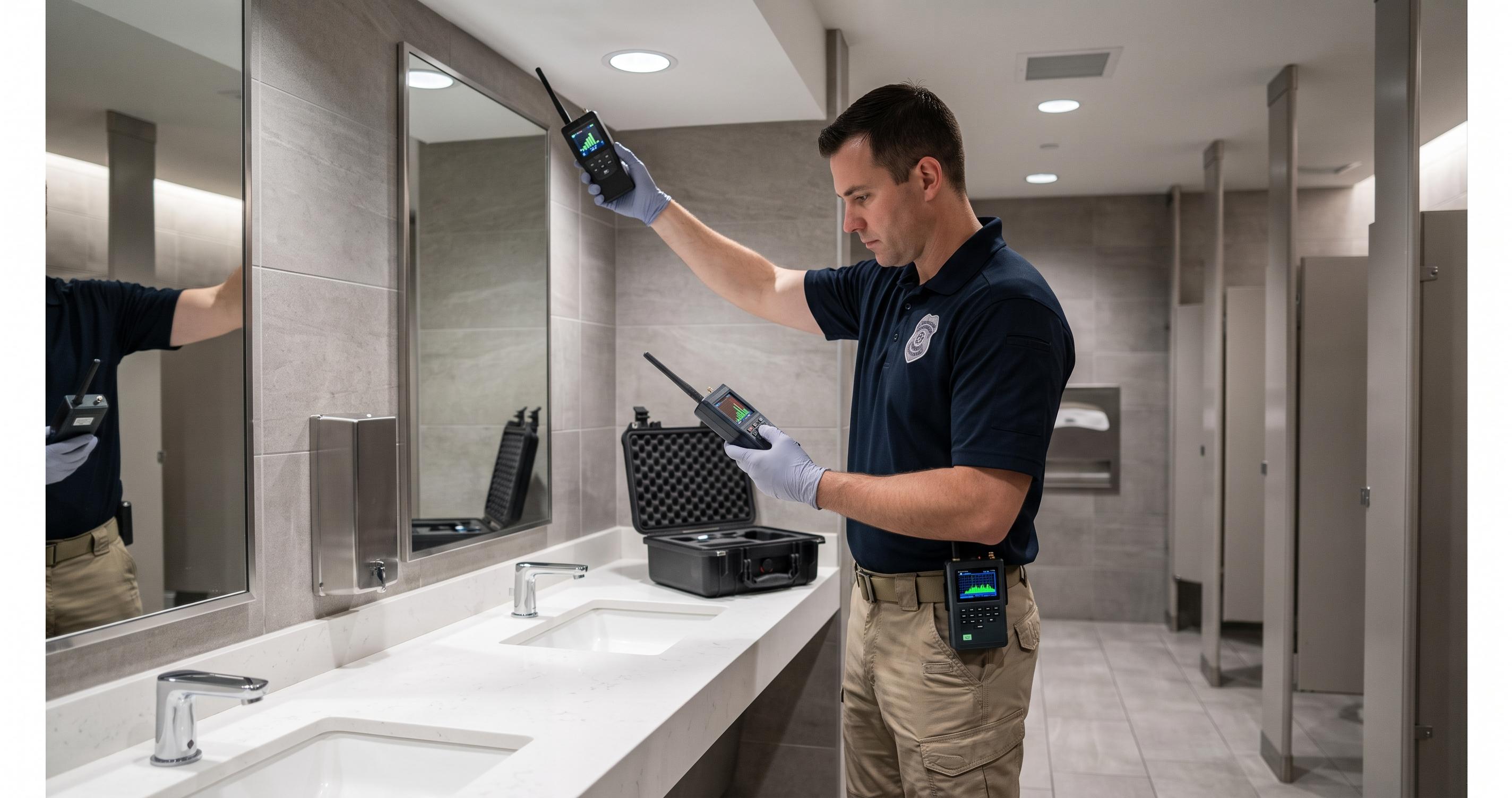
Restrooms are expected to be private spaces, but concerns about hidden surveillance devices have made security inspections increasingly important. Restroom bug sweeps are designed to help identify potential electronic surveillance equipment, including concealed cameras, microphones, transmitters, and other unauthorized monitoring devices. For businesses, property managers, and individuals, professional inspections can provide an additional layer of privacy protection where confidentiality is especially important.
A restroom should never be treated as an ordinary area when privacy and personal security are being considered. Because small surveillance devices can potentially be concealed in everyday objects, a systematic inspection may be necessary when there are reasonable concerns about unauthorized monitoring.
What Are Restroom Bug Sweeps?
A bug sweep is a technical inspection intended to identify potential surveillance equipment or other electronic devices that may have been placed without authorization. Depending on the inspection, specialists may assess both the physical environment and the radio-frequency or electronic activity present within the area.
The purpose is not simply to look around the room. A professional inspection can involve specialized detection equipment, physical checks, environmental assessment, and technical analysis.
Common areas that may be inspected include:
- Ceiling fixtures and vents
- Light fittings
- Electrical outlets and switches
- Mirrors and surrounding fixtures
- Air-conditioning components
- Wall and ceiling spaces
- Cabinets and other installed fixtures
- Unusual or recently modified objects
- Areas where unauthorized equipment could potentially be concealed
The exact inspection process depends on the environment, the suspected threat, and the equipment being used.
Why Are Restrooms Considered High-Privacy Areas?
Restrooms have an obvious expectation of privacy. Unlike offices, reception areas, or public corridors, people generally have a reasonable expectation that they will not be recorded or monitored while using restroom facilities.
That makes unauthorized surveillance in these areas particularly serious.
Businesses should take privacy concerns seriously because an overlooked device could create reputational, legal, and security problems. Employees and visitors may also feel unsafe if they believe their privacy has been compromised.
For organizations, preventive inspections can therefore become part of a broader security and privacy strategy.
How Do Bug Sweeps Detect Potential Surveillance Devices?
Professional bug sweeps may use several methods because no single detection technique is suitable for every type of device.
Radio Frequency Detection
Some surveillance equipment communicates wirelessly. RF detection equipment can be used to identify unusual radio-frequency activity within a specified environment.
However, radio-frequency activity does not automatically mean that a surveillance device is present. Legitimate wireless equipment can also generate signals, so findings should be assessed carefully.
Physical Inspection
A technical inspection may also involve checking the physical environment for objects or installations that appear unusual.
Physical inspection is important because some devices may not transmit continuously. A device that is inactive, wired, or designed to store information locally may not produce an easily detectable wireless signal.
Electronic Analysis
Depending on the circumstances, specialists may examine electrical or electronic activity for abnormalities.
This type of inspection should be performed systematically rather than relying on assumptions. Legitimate equipment should be distinguished from potentially unauthorized devices before conclusions are made.
Why Professional Inspection Can Be More Effective
Consumer-grade detectors are widely available, but using one does not necessarily provide a complete security assessment.
A professional inspection can be more comprehensive because the environment can be evaluated using multiple techniques.
For example:
- Potential RF sources can be assessed.
- Physical fixtures can be examined.
- Suspicious objects can be documented.
- Normal wireless equipment can be identified.
- Environmental factors can be considered.
- Findings can be reviewed before conclusions are reached.
The inspection process should be evidence-based. A device should not automatically be classified as surveillance equipment simply because a detector produces an alert.
When Should a Restroom Be Inspected?
There is no universal schedule that applies to every restroom. The appropriate frequency depends on the environment and the organization's risk profile.
An inspection may be considered when:
- A suspicious object has been discovered.
- A fixture appears to have been recently altered.
- Unauthorized access to the restroom has been reported.
- Someone reports a privacy concern.
- Renovation or maintenance work has recently occurred.
- A high-security organization wants additional privacy assurance.
- A new commercial property is being occupied.
- There are concerns about unauthorized surveillance within the premises.
When a specific concern has been raised, the situation should be documented and handled carefully rather than relying on speculation.
What Makes a Restroom Bug Sweep Thorough?
A thorough inspection should consider more than simply scanning the room for signals.
The environment should be approached methodically. Areas that contain electrical equipment, installed fixtures, or objects capable of concealing technology may require closer examination.
A strong inspection generally includes:
- Initial assessment: The environment and security concern are documented.
- Physical inspection: Fixtures and accessible areas are examined.
- Technical detection: Appropriate electronic detection methods are used.
- Signal evaluation: Potentially suspicious signals are assessed against legitimate sources.
- Documentation: Relevant findings are recorded.
- Follow-up: Suspicious findings are investigated before any final conclusion is made.
This structured approach can reduce false alarms and help ensure that important areas are not overlooked.
Common Places That May Require Attention
Hidden devices can potentially be incorporated into ordinary-looking objects. This is why inspectors may pay particular attention to areas that have recently changed or contain unusual installations.
Potential inspection points can include:
- Ventilation areas
- Light fixtures
- Electrical fittings
- Decorative objects
- Mirrors and nearby structures
- Ceiling panels
- Plumbing-related access areas
- Maintenance-access spaces
- Unfamiliar electronic components
It is important to avoid assuming that every unusual object is malicious. Many restroom components are naturally associated with electrical, plumbing, ventilation, and maintenance systems.
Restroom Sweeps for Businesses
Businesses have a responsibility to provide employees and customers with an environment where privacy concerns are taken seriously.
For offices, restaurants, hotels, entertainment venues, healthcare facilities, and other commercial properties, restroom privacy can be part of a broader security policy.
Businesses may benefit from establishing clear procedures for handling reports of suspicious devices.
A practical process could include:
- Recording the reported concern.
- Restricting unnecessary access to the affected area.
- Avoiding unnecessary disturbance of suspicious objects.
- Contacting qualified security professionals.
- Preserving relevant evidence where appropriate.
- Reviewing access records if necessary.
- Documenting the inspection and findings.
If a suspected surveillance device is discovered, organizations should also consider seeking appropriate legal or law-enforcement guidance based on their jurisdiction.
The Importance of Evidence-Based Security
Security inspections should be based on evidence rather than fear.
A detector reading, unusual object, or unexplained signal can justify further investigation, but it does not automatically establish that someone is conducting surveillance.
This distinction is particularly important in environments containing many legitimate electronic devices.
For example, Wi-Fi equipment, Bluetooth devices, mobile phones, wireless access points, and other electronics can create detectable signals. Professional interpretation is therefore important when technical findings are reviewed.
A proper inspection report should clearly separate confirmed findings from observations that require additional investigation.
Can a Sweep Guarantee Complete Privacy?
No security inspection should be presented as an absolute guarantee.
Technology changes, environments vary, and different surveillance methods can require different detection approaches. Some devices may be difficult to identify under certain circumstances.
For that reason, a bug sweep should be considered one component of a wider privacy and security program.
Additional measures can include:
- Controlled access to private areas
- Regular maintenance oversight
- Employee security awareness
- Monitoring unauthorized access
- Documenting changes to fixtures
- Establishing a reporting procedure
- Conducting periodic security assessments when justified
A layered approach is generally more reliable than depending on one detection method.
What Should You Look for in a Professional Sweep Service?
Anyone arranging an inspection should consider the provider's experience, methodology, equipment, documentation, and professionalism.
Before hiring a service, consider asking:
- What inspection methods are used?
- What areas are included?
- Will findings be documented?
- How are false positives evaluated?
- What happens if suspicious equipment is discovered?
- Is the inspection conducted confidentially?
- Does the provider explain its findings clearly?
Experience matters because technical detection involves interpretation as well as equipment.
A credible provider should be transparent about what the inspection can and cannot establish.
Protecting Privacy Through Preventive Measures
Privacy protection does not always have to begin after a suspicious incident. Preventive security practices can help organizations identify problems earlier.
Property managers and business owners can maintain better oversight by documenting maintenance work, controlling access to restricted areas, and encouraging employees to report unusual changes.
If fixtures are regularly inspected and modifications are properly recorded, unexpected changes may be easier to identify.
Similarly, security personnel should know how to respond when a privacy concern is reported. Employees should not be encouraged to dismantle suspicious equipment themselves, as doing so could potentially damage evidence or create unnecessary risks.
Why Documentation Matters
Documentation can provide an important record of what was found during an inspection.
A professional report may include information such as:
- Date and time of inspection
- Areas examined
- Inspection methodology
- Relevant technical observations
- Identified legitimate signal sources
- Suspicious findings
- Photographic documentation where appropriate
- Recommended follow-up actions
Clear documentation can be particularly valuable for businesses that need to demonstrate that privacy concerns were taken seriously.
It also provides a reference point for future inspections.
A Responsible Approach to Restroom Security
Privacy security should always be approached responsibly. Inspections should be performed with appropriate authorization and within applicable laws and regulations.
If a suspected hidden camera or other surveillance device is discovered, individuals should avoid unnecessarily handling it. The appropriate response may involve securing the area, documenting the discovery, and contacting qualified professionals or relevant authorities.
The objective of a security sweep should be to establish facts and protect privacy, not to create unnecessary alarm.
Final Thought
Restroom bug sweeps can provide an important layer of privacy protection when there are legitimate concerns about unauthorized surveillance. A professional inspection combines technical detection with careful physical assessment and evidence-based analysis. While no inspection can guarantee absolute security, regular risk assessments, controlled access, proper documentation, and qualified technical inspections can significantly strengthen privacy practices. For businesses and property managers, treating restroom privacy as an important part of overall security can help create a safer and more trustworthy environment for employees, customers, and visitors.



 Turkish
 English
 Arabic
 French
 Spanish
 Portuguese
 Deutsch
 Dutch
Dutch
 Italiano
 Russian
 Romaian
 Portuguese (Brazil)
 Greek
Greek