


Commercial Energy Storage System Guide: Maximize ROI & Resilience
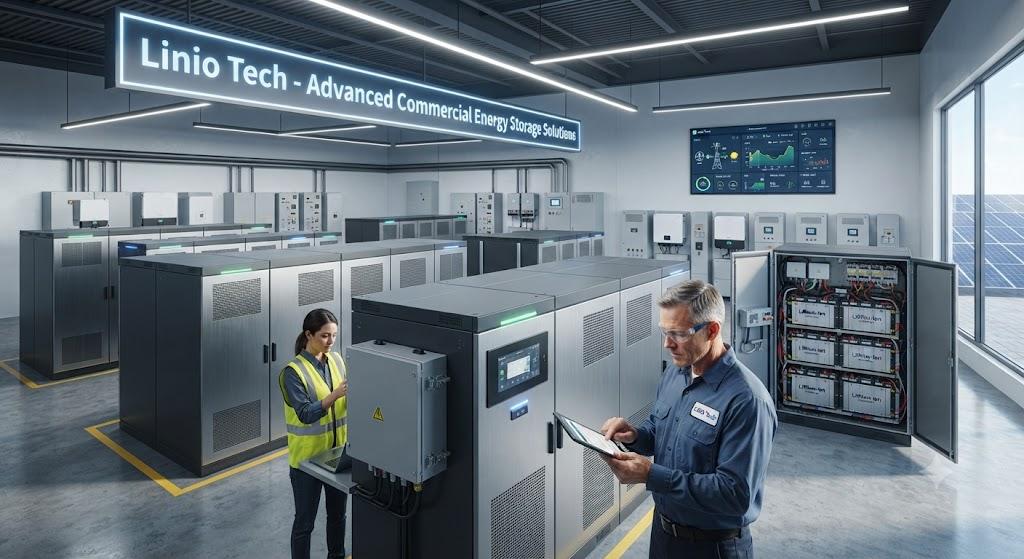
As commercial electricity rates rise and grid stability grows increasingly unpredictable, businesses face significant challenges in managing operational costs. Whether running a manufacturing plant, a retail logistics center, or a corporate office facility, energy expenses constitute a substantial portion of overall overhead.
A Commercial Energy Storage System (CESS)—often referred to as a Battery Energy Storage System (BESS)—has become an indispensable asset for modern enterprise energy management. By storing low-cost electricity from the grid or on-site renewable sources like solar arrays, enterprises can deploy stored energy during peak tariff hours or unexpected power outages.
This guide examines how commercial energy storage systems work, their financial advantages, key technical specs, and best practices for system selection.
How a Commercial Energy Storage System Works
At its core, a commercial energy storage system captures electrical power from solar panels or the grid during off-peak periods and holds it in high-capacity battery units until it is needed.
A complete commercial storage architecture comprises four main elements:
Battery Modules: High-density cells—typically Lithium Iron Phosphate ($\text{LiFePO}_4$)—that store direct current ($\text{DC}$) electricity safely over thousands of charge cycles.
Power Conversion System (PCS) / Inverter: Inverts stored $\text{DC}$ power into three-phase alternating current ($\text{AC}$) power required for industrial machinery and commercial building distribution.
Battery Management System (BMS): Monitors cell voltage, thermal parameters, and state-of-charge to maintain long-term operation.
Energy Management System (EMS): Software controls that analyze real-time energy usage patterns to automatically trigger charging, discharging, or grid isolation.
Key Financial Benefits for Enterprise Operations
For commercial and industrial enterprises, a battery energy storage system functions as a financial instrument designed to reduce utility bills and stabilize operational expenses.
Peak Shaving and Demand Charge Mitigation
Utility companies evaluate commercial accounts using two metrics: overall energy consumption (kWh) and peak demand charges (kW). Peak demand charges are calculated based on a facility's highest power draw during a brief 15-to-30-minute interval within a billing cycle. In many regions, these charges account for up to 50% of the total monthly electric bill.
A commercial energy storage system executes peak shaving by automatically discharging stored battery power when the facility's demand surges. Capping maximum grid draw directly lowers expensive demand penalties.
Time-of-Use (TOU) Energy Arbitrage
Under Time-of-Use rate structures, electricity prices peak during specific high-demand hours (typically late afternoon to evening). Battery storage enables energy arbitrage: charging during off-peak hours when rates are lowest (or using zero-cost daytime solar power) and discharging during high-rate periods to minimize utility expenses.
Maximizing On-Site Solar Utilization
Without battery storage, excess electricity generated by commercial solar panels is exported back to the grid at low feed-in tariff rates. Pairing solar panels with a energy storage system allows businesses to retain 100% of their renewable energy, using it during night shifts or cloudy conditions.
Operational Continuity and Disaster Preparedness
Beyond direct monetary savings, commercial battery storage protects business operations from grid failures.
       [ Solar Array / Utility Grid ]
                     │
                     ▼
  [ Commercial Energy Storage System (BMS/PCS) ]
                     │
        ┌────────────┴────────────┐
        ▼                         ▼
 [ Peak Shaving &           [ Uninterrupted ]
   Cost Arbitrage ]         Backup Power
Uninterrupted Power Supply (UPS) Backup
Brief voltage sags or extended blackouts can cause heavy financial losses through interrupted production, damaged inventory, and server downtime. Modern commercial storage platforms transition to battery backup within milliseconds, maintaining continuous power to critical infrastructure.
Microgrid Integration
For remote operations or sites with unstable utility connections, commercial energy storage serves as the backbone of an independent microgrid, enabling self-sustained off-grid functionality.
Evaluating Technical Parameters for Your Facility
Selecting an appropriate storage architecture requires reviewing system safety, lifetime durability, and modular expandability.
| Feature / Metric | Target Standard | Operational Value |
| Battery Chemistry | $\text{LiFePO}_4$ (Lithium Iron Phosphate) | Provides exceptional thermal stability, non-combustible properties, and 6,500–8,500+ lifespan cycles. |
| Safety Certifications | UL 9540, UL 9540A, UL 1973 | Ensures compliance with commercial fire safety standards and building code requirements. |
| Depth of Discharge (DoD) | 80% to 95% DoD | Maximizes usable energy storage capacity per cycle without compromising battery longevity. |
| Scalability | Modular Enclosures | Allows capacity expansion as facility power demands grow over time. |
Steps to Implement a Commercial Storage System
Analyze Utility Load Curves: Examine 12–24 months of 15-minute interval power data to identify peak usage spikes and utility tariff structures.
Right-Size Capacity: Target high-return load profiles (such as peak shaving) rather than over-sizing for 100% off-grid coverage, ensuring faster financial payback.
Leverage Tax Credits and Incentives: Combine federal investment tax credits (ITC), local clean-energy grants, and accelerated depreciation (MACRS) to lower initial capital expenditure.
Conclusion
A commercial energy storage system is a strategic operational investment that reduces overhead, maximizes renewable energy assets, and protects facilities against costly power interruptions. By leveraging peak shaving, TOU arbitrage, and seamless emergency backup, enterprises can secure a resilient, cost-effective energy future.
When upgrading your facility's energy infrastructure, rely on Linio Tech. Featuring premium $\text{LiFePO}_4$ battery systems, UL-certified modular enclosures, and advanced hybrid inverter integrations, Linio tech delivers the robust commercial energy storage systems necessary to optimize your power management, cut operating expenses, and sustain long-term business growth.
 English
 Arabic
 French
 Spanish
 Portuguese
 Deutsch
 Turkish
 Dutch
Dutch
 Italiano
 Russian
 Romaian
 Portuguese (Brazil)
 Greek
Greek