


More Linen, Same Staff—When Should Laundry Finishing Equipment Replace Manual Work?
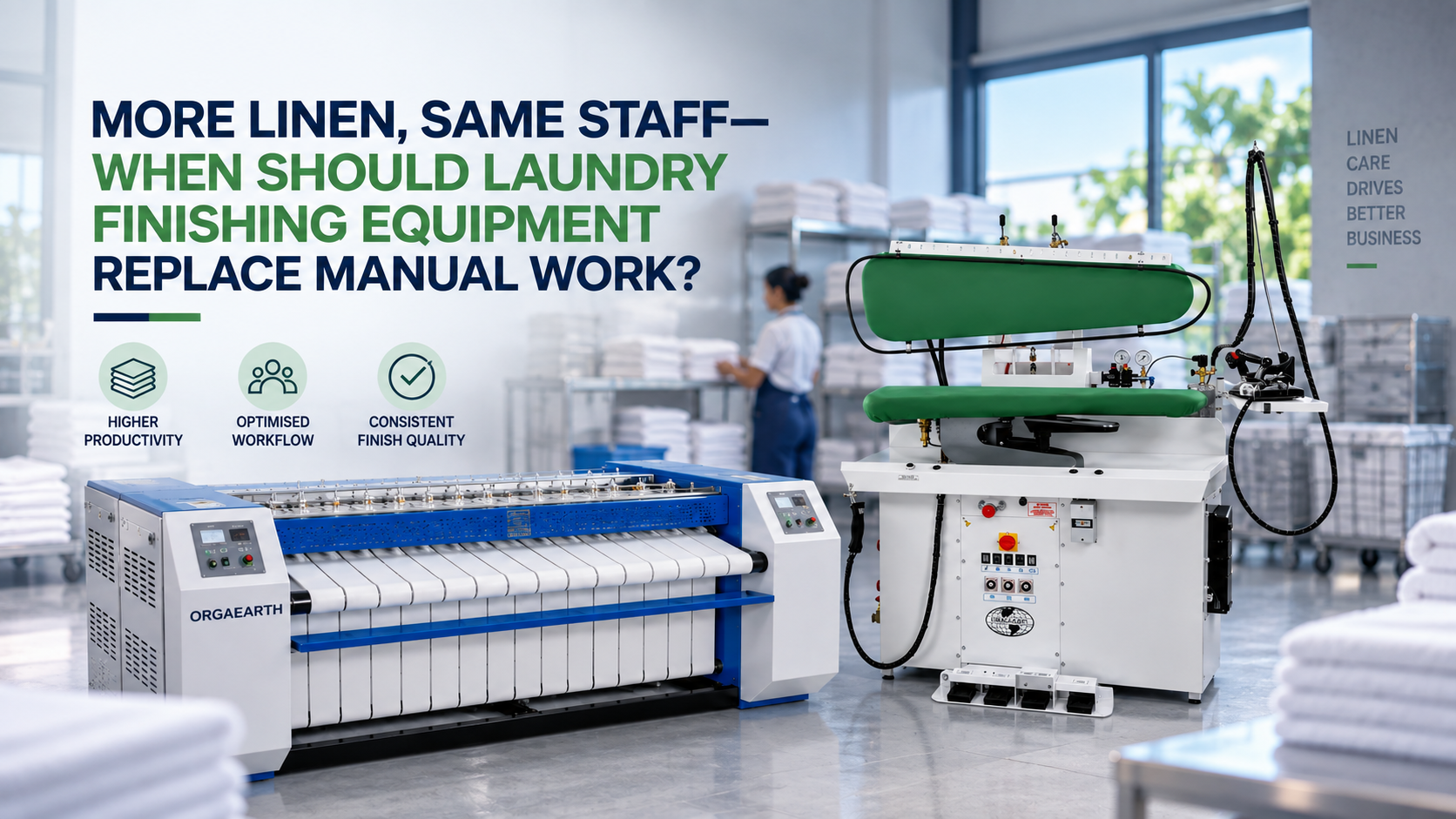
Your washers and dryers may be handling growing linen volumes, but what happens when clean linen starts waiting for ironing, pressing, folding or finishing? As hotel and commercial laundry volumes increase, manual finishing can become the stage that limits daily output. The right laundry finishing equipment can help increase processing capacity and support consistent turnaround—but only when the investment matches your actual linen volume and workflow.
When Does Manual Linen Finishing Start Limiting Laundry Output?
Manual finishing can work effectively when volumes are manageable. The problem begins when incoming linen increases faster than the finishing section can process it.
Imagine the washing and drying sections finish their planned production by afternoon, but sheets and other linen continue waiting for ironing or folding late into the shift. Your washing capacity is available, yet finished orders cannot move to quality checking and dispatch.
Common warning signs include:
-
Clean linen regularly waiting for finishing
-
Finishing continuing after washing and drying are complete
-
Increasing overtime during high-volume days
-
Staff struggling during peak hotel linen loads
-
Turnaround becoming inconsistent as volume increases
-
Large quantities of repetitive flat linen requiring manual handling
-
New contracts putting additional pressure on the same finishing team
This is a laundry productivity problem because overall output depends on the complete process:
Receiving → Sorting → Washing → Drying → Finishing → Quality Check → Packing → Dispatch
If finishing is the slowest stage, purchasing additional washing capacity may simply create a larger queue of clean linen.
Before expanding your laundry, therefore, identify where work consistently accumulates.
How Much Linen Can Your Current Finishing Team Actually Handle Per Shift?
Do not decide whether you need commercial laundry finishing equipment based only on the number of employees in your finishing department.
Measure actual output.
Start by separating the linen categories you process. Hotel bedsheets, pillowcases, table linen, uniforms and guest garments can have very different finishing requirements.
Then record:
-
Pieces processed per hour
-
Pieces processed per shift
-
Productive finishing hours
-
Number of employees involved
-
Linen waiting at the beginning and end of the shift
-
Peak-day volume
-
Overtime required
-
Different linen categories being processed
For flat linen, a simple measurement can be:
Finishing Output Per Hour = Total Finished Pieces ÷ Productive Finishing Hours
For example, if your team finishes 800 pieces during eight productive hours:
800 ÷ 8 = 100 pieces per hour
This is only an illustrative calculation, not an industry benchmark.
You can then compare current output with expected demand:
Finishing Capacity Gap = Required Daily Finishing Volume − Practical Daily Finishing Output
Suppose a new hotel contract increases the requirement to 1,200 pieces per day while your current process practically handles 900 pieces during the available shift. You now have a measurable capacity gap rather than simply a feeling that staff are busy.
This data makes it easier to determine whether better scheduling, additional manpower or linen finishing equipment should be considered.
Which Laundry Finishing Equipment Can Reduce Manual Work?
There is no single laundry finishing machine suitable for every textile. Equipment selection should start with what your laundry actually processes.
Flatwork ironer
A flatwork ironer machine is designed for suitable flat linen such as sheets and table linen. It can become relevant where large volumes of repetitive flatwork create significant manual ironing requirements.
When comparing models, consider the manufacturer's specified working width, roller configuration, operating speed and other processing requirements rather than choosing on machine size alone.
Automatic flatwork feeder
In higher-volume flatwork operations, feeding itself can require considerable manual handling. A compatible feeder can support the movement of suitable linen into the ironing process.
Its value depends on the volume being processed and compatibility with the rest of the finishing line.
Folding equipment
After ironing, folding can become another labor-intensive stage. Suitable folding systems can support repetitive linen processing where the volume justifies the investment.
Utility or steam press
Presses can be useful for garments or linen that require a different finishing process from flatwork.
The correct machine depends on garment type, fabric and required finish.
Finishing or ironing table
A professional finishing table remains useful for garments and items that require operator control rather than continuous flatwork processing.
The important point is that industrial laundry finishing equipment should not be purchased simply because manual work exists.
The decision should follow:
Linen Type → Daily Volume → Required Finish → Current Bottleneck → Suitable Equipment
This helps avoid investing in a machine that does not match your actual workload.
Should You Add More Staff or Invest in Laundry Finishing Equipment?
This is one of the most important questions for a growing commercial laundry.
Adding staff may make sense when volumes are still developing, workloads fluctuate significantly, or the finishing work includes many different garment types requiring manual handling.
Investing in commercial ironing equipment may become more relevant when large quantities of similar linen must be processed consistently.
Compare the two options across several factors.
Workload consistency: Is the higher volume present every day, or only occasionally?
Type of work: Repetitive flat linen may create a different equipment opportunity from varied garments requiring individual finishing.
Available operating hours: If the team can no longer complete production within the normal shift, additional capacity may be required.
Space and utilities: An industrial ironing machine or finishing line requires suitable installation space, workflow planning and applicable utilities.
Future contracts: Confirmed or realistically expected linen volume matters more than purchasing equipment based only on hoped-for growth.
Labor requirements: Equipment can change how staff are deployed, but it should not automatically be viewed as eliminating people. Operators may still be required for feeding, handling, quality control, sorting, folding or other process stages depending on the equipment configuration.
The better question is not:
“Can a machine replace my staff?”
It is:
“Which combination of people, process, and equipment gives my laundry the practical output it needs?”
That leads to a more useful laundry equipment investment decision.
What Should You Calculate Before Investing in Linen Finishing Equipment?
Before purchasing laundry equipment for hotels or a commercial finishing operation, understand what the investment needs to solve.
Start with daily volume.
How many sheets, pillowcases, table linens, uniforms or other items require finishing each day? How much does this increase during peak periods?
Next, calculate available production time and current practical output.
Then consider:
-
Linen and garment types
-
Required finishing quality
-
Daily and peak processing volume
-
Productive operating hours
-
Current pieces processed per hour
-
Existing staff requirement
-
Feeding and handling requirements
-
Available floor space
-
Applicable utility requirements
-
Compatibility between machines
-
Service and maintenance access
-
Expected future contracts
Also calculate more than the equipment purchase price:
Total Finishing Investment = Equipment + Installation + Site Preparation + Utility Requirements + Supporting Equipment
If considering a larger finishing line, review the entire production flow.
For example, increasing ironing speed has limited value if feeding cannot keep up. Similarly, faster ironing followed by slow manual folding may simply move the bottleneck to the next stage.
Your laundry finishing capacity should therefore be evaluated as a process rather than as the rated output of one machine.
How Orgaearth Can Help
Orgaearth can help commercial, hotel, and institutional laundry businesses evaluate their finishing requirements based on linen type, processing volume, available space, utilities, and operational workflow.
Depending on the application, this can include evaluating suitable laundry finishing equipment such as flatwork systems, presses, finishing tables, and other supporting equipment.
The objective is to select equipment around the actual finishing requirement instead of simply adding machinery to an existing process. A balanced washing, drying, and finishing setup can better support increasing linen volumes and future business growth.
Frequently Asked Questions
When should I invest in laundry finishing equipment?
Consider equipment when finishing repeatedly becomes a bottleneck, clean linen regularly waits for processing, overtime increases, or confirmed volume exceeds your practical manual finishing capacity.
What laundry finishing equipment is used for hotel linen?
Depending on the linen and operation, equipment may include flatwork ironers, feeders, folders, presses, and finishing tables. Selection should be based on linen type, volume, and required finish.
Can a flatwork ironer reduce manual ironing?
For suitable flat linen and the right operational setup, a flatwork ironer can increase processing capacity compared with relying entirely on manual ironing. Actual output depends on the machine, linen, feeding process, and operating conditions.
How do I calculate laundry finishing capacity?
Measure practical pieces processed per productive hour and multiply that by available productive operating time. Compare this output with normal and peak daily finishing requirements.
Should I hire more staff or buy commercial laundry finishing equipment?
It depends on workload consistency, linen type, current output, labor requirements, space, utilities, and future volume. Equipment may make more sense for consistent repetitive workloads, while manual processes can remain important for varied or specialized finishing.
Contact Us
Orgaearth Laundry Solutions
Plot no. 774, Udyog Vihar, Phase 5, Gurugram, Haryana, India-122016
Email: marketing@orgaearth.com
Contact No.- +91 7042912777
Tags:
 Russian
 English
 Arabic
 French
 Spanish
 Portuguese
 Deutsch
 Turkish
 Dutch
Dutch
 Italiano
 Romaian
 Portuguese (Brazil)
 Greek
Greek