Baking has a funny way of making small details feel very important. A little too much flour can change the texture of a cake. Extra sugar can make cookies spread differently. Too little butter can leave pastries dry, while too much can make them greasy.
That is why baking often feels different from everyday cooking.
When cooking dinner, you can usually adjust things as you go. A little extra seasoning or another splash of water rarely ruins the entire meal. Baking is less forgiving. Ingredients interact with each other in specific ways, and even a small measurement difference can affect the final result.
This is where a Digital Kitchen Scale can become one of the most useful tools in a home baker's kitchen.
Instead of relying entirely on cups and spoons, a kitchen scale lets you measure ingredients by weight. This simple change can make recipes easier to follow, improve consistency, reduce guesswork, and help bakers understand what is actually going into their dough and batter.
You do not need to be a professional pastry chef to benefit from one. Whether you bake cookies on weekends, make bread for your family, or are learning how to decorate cakes, accurate measurements can make the process much smoother.
Why Accuracy Matters So Much in Baking
Baking is often described as a combination of creativity and science. That description makes sense when you look at how ingredients behave.
Flour, sugar, butter, eggs, liquids, yeast, baking powder, and other ingredients each play a particular role. Changing their proportions can change the structure, moisture, rise, flavor, and texture of the finished product.
Consider flour as a simple example.
If you scoop flour directly from a container using a measuring cup, you may accidentally pack more flour into the cup than the recipe intended. If another person uses the same cup but lightly fills it, they may end up with a different amount.
Both people followed the same volume measurement, yet they may use different quantities of flour.
Weight solves much of this uncertainty.
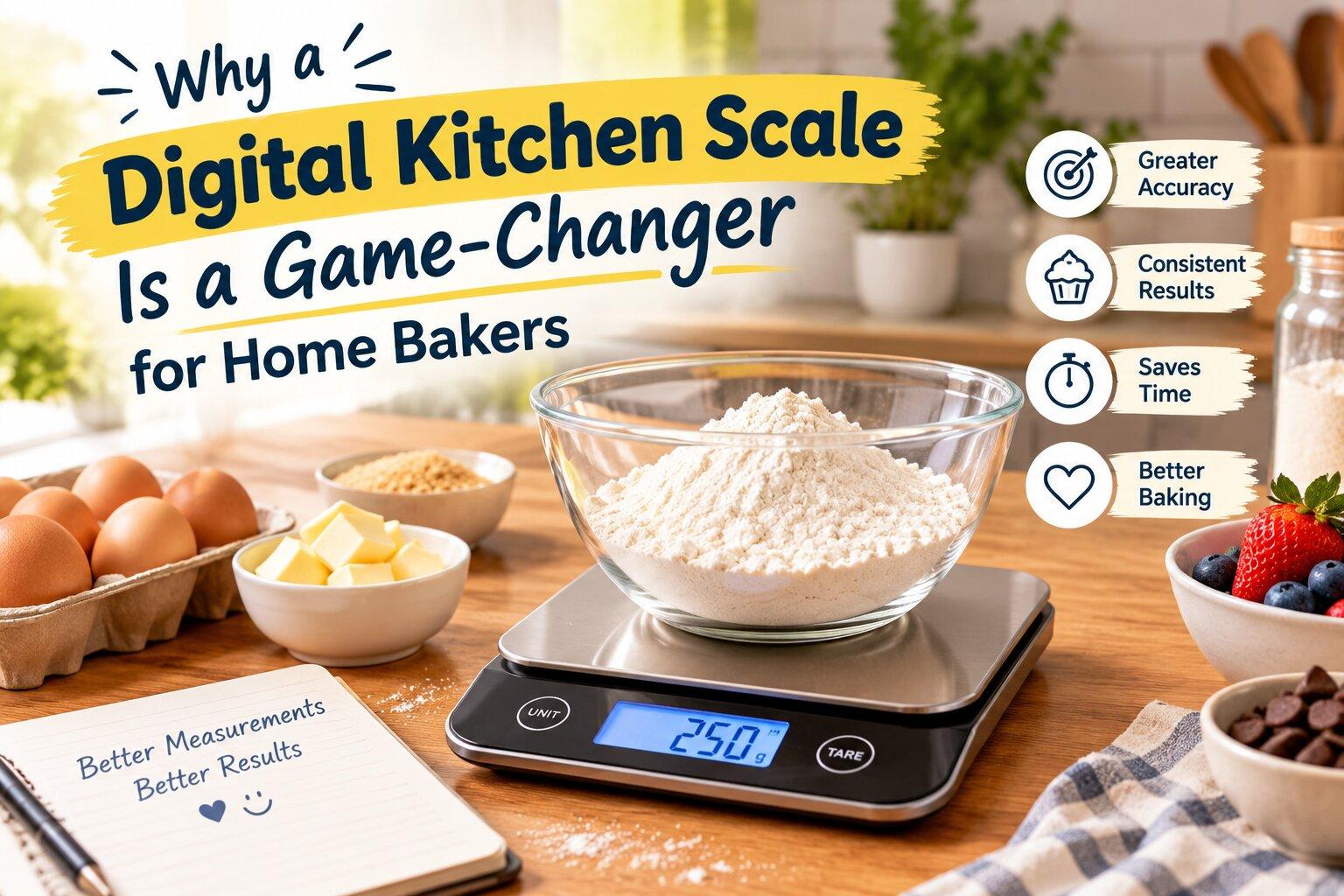
A recipe calling for 250 grams of flour gives you a specific target. You do not have to guess whether your cup is packed or loosely filled.
That level of consistency is one reason a Digital Kitchen Scale can make such a noticeable difference for home bakers.
What Is a Digital Kitchen Scale?
A digital kitchen scale is a small electronic device designed to measure the weight of food and ingredients.
Most models have a flat weighing surface, a digital display, and controls for functions such as turning the scale on, changing measurement units, or resetting the weight.
Instead of measuring an ingredient by volume, you place a bowl or container on the scale and measure the ingredient by weight.
Many scales allow users to switch between units such as grams, ounces, pounds, or milliliters, although the exact measurement options vary by model. It is important to remember that volume and weight are not interchangeable for every ingredient. A milliliter measurement is a volume measurement, while grams measure mass.
For baking, grams are particularly useful because many recipes use weight-based measurements.
1. It Takes the Guesswork Out of Measuring Flour
Flour is one of the easiest ingredients to measure inconsistently.
Scoop a cup from a bag and you might compress the flour. Spoon flour gently into the cup and the amount may be lighter. Leveling the top helps, but differences can still occur depending on the measuring method.
A scale offers a more direct approach.
If your recipe says 300 grams of flour, you can simply add flour until the display reaches 300 grams.
That does not require you to worry about whether the flour is packed correctly or whether your measuring cup is slightly different from the one used by the recipe creator.
For new bakers, this can make recipes much easier to understand.
2. It Helps Produce More Consistent Results
One of the most frustrating baking experiences is making something delicious once and then struggling to recreate it.
You may remember the recipe perfectly, but the second batch turns out different.
Measurement is one possible reason.
When ingredients are measured by volume, small variations can occur each time you bake. Measuring by weight gives you a more repeatable process.
If a successful cookie recipe requires 200 grams of flour, 100 grams of butter, and 150 grams of sugar, you can reproduce those quantities more precisely each time.
The result is not guaranteed to be identical because many other factors affect baking, including oven temperature, ingredient condition, mixing technique, and baking time. Still, accurate ingredient measurement removes one major source of variation.
3. It Makes Recipe Scaling Much Easier
Sometimes a recipe is perfect except for the quantity.
Maybe you want to make half a batch of cookies. Perhaps you need to double a bread recipe for a family gathering.
Working with cups and spoons can become awkward when measurements involve fractions.
Weight-based measurements are often much easier to scale.
For example, if a recipe calls for 400 grams of flour and you want half the recipe, you need 200 grams.
If you double it, you need 800 grams.
The same principle applies to most ingredients.
This makes a Digital Kitchen Scale particularly useful when experimenting with recipes or adjusting batch sizes.
4. It Can Make Baking Less Messy
At first, using a scale might seem like it adds another step. In practice, it can actually simplify the process.
Many bakers use one large mixing bowl and measure ingredients directly into it.
Place the empty bowl on the scale and use the tare function to bring the display back to zero. Add the first ingredient, reset the scale, and continue with the next one.
Instead of filling several measuring cups, leveling them, and transferring ingredients, you can sometimes measure everything directly into one bowl.
Fewer measuring tools can mean fewer dishes waiting in the sink.
That is a small advantage, but anyone who has baked a large batch of cookies knows that fewer dishes are always welcome.
5. It Helps With Bread Baking
Bread is an area where accurate measurements can be especially valuable.
Flour and water create the foundation of dough, while yeast, salt, sugar, fats, and other ingredients influence how the dough behaves.
Too much flour can produce a stiff dough. Too much water can make it difficult to handle. Small changes can affect the texture and rise of the final loaf.
Bread bakers often use ratios to understand the relationship between ingredients. Once measurements are expressed in grams, it becomes easier to adjust a recipe while keeping those proportions in mind.
This can be helpful for people who want to move beyond following recipes and start developing their own bread formulas.
6. It Helps With Portion Control During Recipe Testing
Home bakers often experiment.
Maybe you want to make smaller cookies. Perhaps you are testing different muffin sizes or trying to divide a cake batter evenly between pans.
A scale can help create more consistent portions.
For example, if you want every cookie dough ball to have approximately the same weight, you can weigh each portion before baking.
This can lead to more evenly sized baked goods.
Uniform portions may also help with baking because pieces of similar size are more likely to finish at roughly the same time.
7. It Makes International Recipes Easier to Follow
Baking recipes come from all over the world.
One recipe might use cups and tablespoons. Another might list everything in grams. A third could use ounces.
A scale that supports common units can make it easier to work with different recipes.
More importantly, learning to bake with weight-based measurements opens the door to recipes that were originally written using grams.
Instead of converting every ingredient into cups, you can follow the original measurements directly.
That can reduce unnecessary calculations and make international baking recipes more accessible.
8. It Can Improve Your Understanding of Baking
A scale does more than measure ingredients. It can teach you how baking works.
Once you start thinking in grams, ingredient relationships become easier to see.
For example, you might notice that one cookie recipe contains a particular amount of flour compared with butter and sugar. Then you can compare that recipe with another and start recognizing why one produces a softer cookie while another creates a crispier result.
Over time, measurements become more than numbers.
They become a way of understanding recipes.
This can be especially useful for bakers who enjoy experimenting instead of simply repeating the same instructions.
9. It Is Useful for More Than Baking
Although baking is an obvious use, a kitchen scale is not limited to cakes and cookies.
It can also help with everyday cooking and meal preparation.
You can use one to measure:
- Coffee beans
- Pasta
- Rice
- Spices
- Nuts
- Cheese
- Meat
- Homemade pizza dough
- Homemade sauces
- Ingredients for meal preparation
Some people also use kitchen scales when following nutrition plans that specify food quantities by weight.
The important thing is to use the scale according to the measurement required by the recipe or task. Weight can provide consistency, but it does not automatically replace volume measurements for liquids or ingredients when a recipe specifically depends on volume.
How to Use a Digital Kitchen Scale Correctly
Using a kitchen scale is straightforward, but a few habits can make the process easier.
Start With a Stable Surface
Place the scale on a flat, stable surface before measuring.
An uneven or unstable surface can make measurements harder to read or repeat.
Use the Tare Function
The tare button is one of the most useful features for bakers.
Place your mixing bowl on the scale and press tare. The display should return to zero.
Add your first ingredient, then press tare again before adding the next one.
This allows you to measure several ingredients in the same bowl without calculating the weight of the bowl or the ingredients already inside.
Choose the Correct Unit
Check whether the recipe uses grams, ounces, or another unit.
If the recipe provides weight measurements, it is usually best to use those measurements directly rather than converting them unnecessarily.
Wait for the Number to Stabilize
Add ingredients gradually and allow the display to settle before stopping.
This becomes particularly important when measuring small quantities.
What Features Should Home Bakers Look For?
You do not necessarily need a complicated scale.
For most home baking, practical features matter more than a long list of extras.
Clear Digital Display
The numbers should be easy to read while you are working.
Tare Function
This is almost essential for convenient baking because it allows you to reset the measurement between ingredients.
Useful Measurement Units
Choose a scale that supports the units you commonly use.
Suitable Capacity
Make sure the scale can handle the combined weight of your bowl and ingredients.
Fine Measurement Increments
A scale capable of measuring small changes can be useful for ingredients that require greater precision.
Easy Cleaning
Baking can get messy. A smooth weighing surface is generally easier to wipe clean.
Common Mistakes Bakers Make With Kitchen Scales
A scale improves accuracy, but it still needs to be used properly.
One common mistake is forgetting to tare the bowl before adding ingredients. This can result in a measurement that includes the bowl's weight.
Another mistake is accidentally changing units in the middle of a recipe.
It is also easy to place the scale on an unstable surface or allow ingredients to interfere with the controls.
Some bakers also assume that every recipe should be converted to grams. That is not always necessary. If a recipe was carefully developed using volume measurements, follow its instructions unless you have a clear reason to convert them.
The goal is consistency, not unnecessary complexity.
Digital Kitchen Scale vs. Measuring Cups
Measuring cups still have a place in the kitchen.
They are quick and convenient for many everyday recipes. They can also be useful when a recipe specifically provides volume measurements.
However, a Digital Kitchen Scale offers a different level of precision because it measures the actual quantity by weight.
For dry ingredients, especially flour, sugar, and similar baking staples, weight-based measurements can reduce some of the variation that comes with different measuring techniques.
The two tools do not have to compete.
Many home bakers keep both available and use whichever method best matches the recipe.
Tips for Getting Better Baking Results
A scale is only one part of successful baking.
For better results, pay attention to the entire process.
Read the recipe completely before starting. Gather your ingredients first. Check whether ingredients should be at room temperature. Measure carefully. Preheat the oven when required.
Follow mixing instructions rather than assuming that longer mixing is always better.
Pay attention to baking time, but also learn to recognize visual and texture cues. Ovens can vary, so the exact time in a recipe may not always be enough by itself.
Finally, take notes when you experiment.
If a recipe turns out particularly well, write down what you did. If something goes wrong, record that too.
The combination of accurate measurement and good notes can help you improve surprisingly quickly.
Why Beginners Can Benefit From Using a Scale
You might think a kitchen scale is something experienced bakers use after mastering the basics.
Actually, beginners can benefit from one too.
Learning accurate measurement from the beginning can prevent habits that are difficult to change later.
Instead of thinking, “This looks like enough flour,” you begin learning what a specific quantity actually means.
That creates a stronger foundation for future baking experiments.
At the same time, there is no need to become obsessed with precision. Baking should still be enjoyable. The purpose of accurate measurement is to make the process more predictable, not to remove the fun from it.
Final Thoughts
A Digital Kitchen Scale may look like a small addition to the kitchen, but it can change the way home bakers approach recipes.
It makes ingredient measurement more consistent, simplifies recipe scaling, reduces some of the guesswork around flour, supports bread baking, helps create evenly sized portions, and can even reduce the number of dishes used during preparation.
More importantly, it encourages bakers to understand the relationship between ingredients instead of simply following measurements blindly.
You do not need an expensive setup or a professional kitchen to start baking with greater precision. A reliable scale, a good recipe, and a little patience can take you a long way.
For anyone who enjoys making bread, cookies, cakes, pastries, or other homemade treats, learning to measure ingredients by weight is a simple skill worth adding to the baking routine.
Sometimes, the biggest improvements come from the smallest changes. In home baking, replacing a little guesswork with accurate measurement can be one of them.



 English
 Arabic
 French
 Spanish
 Portuguese
 Deutsch
 Turkish
 Dutch
Dutch
 Italiano
 Russian
 Romaian
 Portuguese (Brazil)
 Greek
Greek