


How Inventory Replenishment Automation Helps Prevent Stockouts
The available units leave the warehouse on Tuesday. Purchasing notices the shortage on Thursday, and the supplier needs another week to deliver. Meanwhile, sales has accepted orders against stock that will not arrive in time.
For supply chain businesses, the problem begins before the shelf becomes empty. A reorder signal was missed, a supplier date changed, or purchasing worked from an outdated stock report.
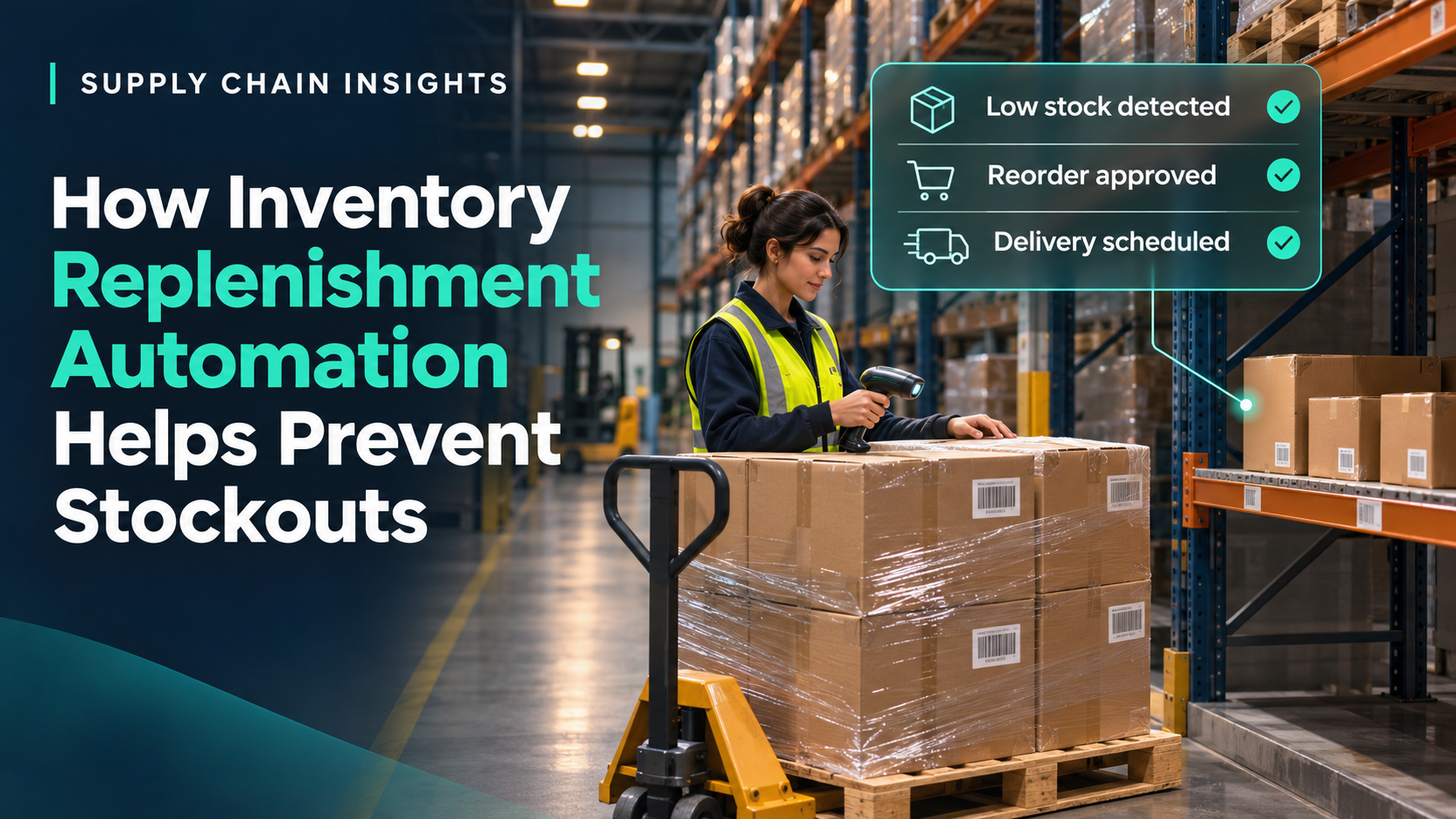
Inventory replenishment automation helps close that gap. It connects stock movements, demand, and incoming supply to defined purchasing or transfer rules, giving teams an earlier opportunity to prevent a shortage.
Reorder before the shortage reaches the customer
Manual replenishment often depends on someone reviewing a spreadsheet or checking low-stock reports. The interval between reviews creates a blind spot, especially for fast-moving products.
An automated process evaluates inventory according to its schedule or transaction triggers. When projected stock crosses a threshold, it can generate a replenishment recommendation, purchase request, or transfer request.
The important word is projected. Current stock alone does not show what will remain after customer commitments and expected receipts are considered.
A useful replenishment view brings together:
- Usable stock at the location.
- Confirmed demand and reservations.
- Outstanding purchase orders and expected arrival dates.
- Supplier lead times and agreed stock buffers.
Reservations must be handled consistently so the same customer demand is not deducted twice.
Set reorder points around the time supply actually takes
A low-stock alert is helpful only if it arrives early enough to act.
For a simple replenishment policy, a common starting point is expected demand during replenishment lead time, plus safety stock. Microsoft’s planning documentation connects reorder points with lead-time demand and describes safety stock as protection against demand fluctuations. learn.microsoft.com
Consider a hypothetical distributor selling 20 units per working day. Its replenishment lead time is five working days, and its safety stock is 40 units. A starting reorder point would be 140 units.
That calculation is a planning example, not a universal setting. Demand variability, supplier reliability, and review frequency affect the buffer required.
Lead time should reflect the full wait until stock becomes usable, including relevant approval, transport, receiving, and inspection time. An accurate supplier dispatch estimate can still produce a late replenishment if internal delays are ignored.
Turn the signal into an owned action
An alert does not replenish a shelf. Someone or something must convert it into a supply action.
Automation can route a proposed order to the buyer, apply spending limits, and request approval when necessary. Routine purchases within rules may qualify for automatic release, while unusual quantities or price changes remain subject to review.
Useful controls include checking for an existing order, respecting pack sizes and minimum quantities, and confirming the destination.
Each request also needs an owner and response deadline. Otherwise, a business can replace a forgotten spreadsheet row with an equally forgotten notification.
Respond when supply dates change
A purchase order raised on time can still arrive late.
Replenishment automation should continue monitoring open supply after the initial request. If a confirmed delivery moves beyond the date stock is needed, the system should flag the affected items and customer commitments.
The buyer or planner can then assess options such as:
- Bringing forward part of an existing delivery.
- Transferring available stock from another location.
- Purchasing from an approved alternative supplier.
- Revising customer commitments before dispatch is due.
These actions require different levels of authority. The workflow should make those boundaries clear and record the decision taken.
Connect warehouse events with purchasing decisions
Replenishment rules depend on reliable inventory records. Unrecorded damage, delayed dispatch updates, and returns awaiting inspection can all distort the stock position.
Warehouse, order management, and ERP systems need agreed definitions for usable, reserved, and incoming stock. Failed updates should be visible and assigned for correction.
There is also a difference between replenishing the warehouse and replenishing a picking location. Stock may exist in reserve storage while the picking bin is empty. Internal transfer automation can help prevent that local shortage from delaying an otherwise fulfilable order.
Measure service improvements alongside inventory growth
Buying more can reduce some shortages while increasing excess stock. Evaluate automation against both outcomes.
Track stockout frequency by item and location, orders delayed by unavailable stock, emergency purchasing, and supplier delivery performance. Review these alongside inventory value and slow-moving stock.
Start with a product group that experiences recurring shortages. Establish a baseline, validate the records, and test proposed replenishment orders before expanding automatic release.
Conclusion
Inventory replenishment automation helps prevent stockouts by identifying shortage signals earlier, making supply actions clearer, and enabling businesses to respond quickly to changing demand. Supply Chain Digital Transformation Services support this process by improving data accuracy, connecting inventory workflows, and streamlining purchasing decisions.
Its effectiveness depends on accurate records, realistic lead times, and purchasing rules that reflect how the business operates. Begin with the products causing repeated delays, connect the relevant workflows, and measure whether availability improves without unnecessary stock growth.
 Turkish
 English
 Arabic
 French
 Spanish
 Portuguese
 Deutsch
 Dutch
 Italiano
 Russian
 Romaian
 Portuguese (Brazil)
 Greek