


Project Sign Boards: Types, Uses and Buying Guide for UAE Construction Sites
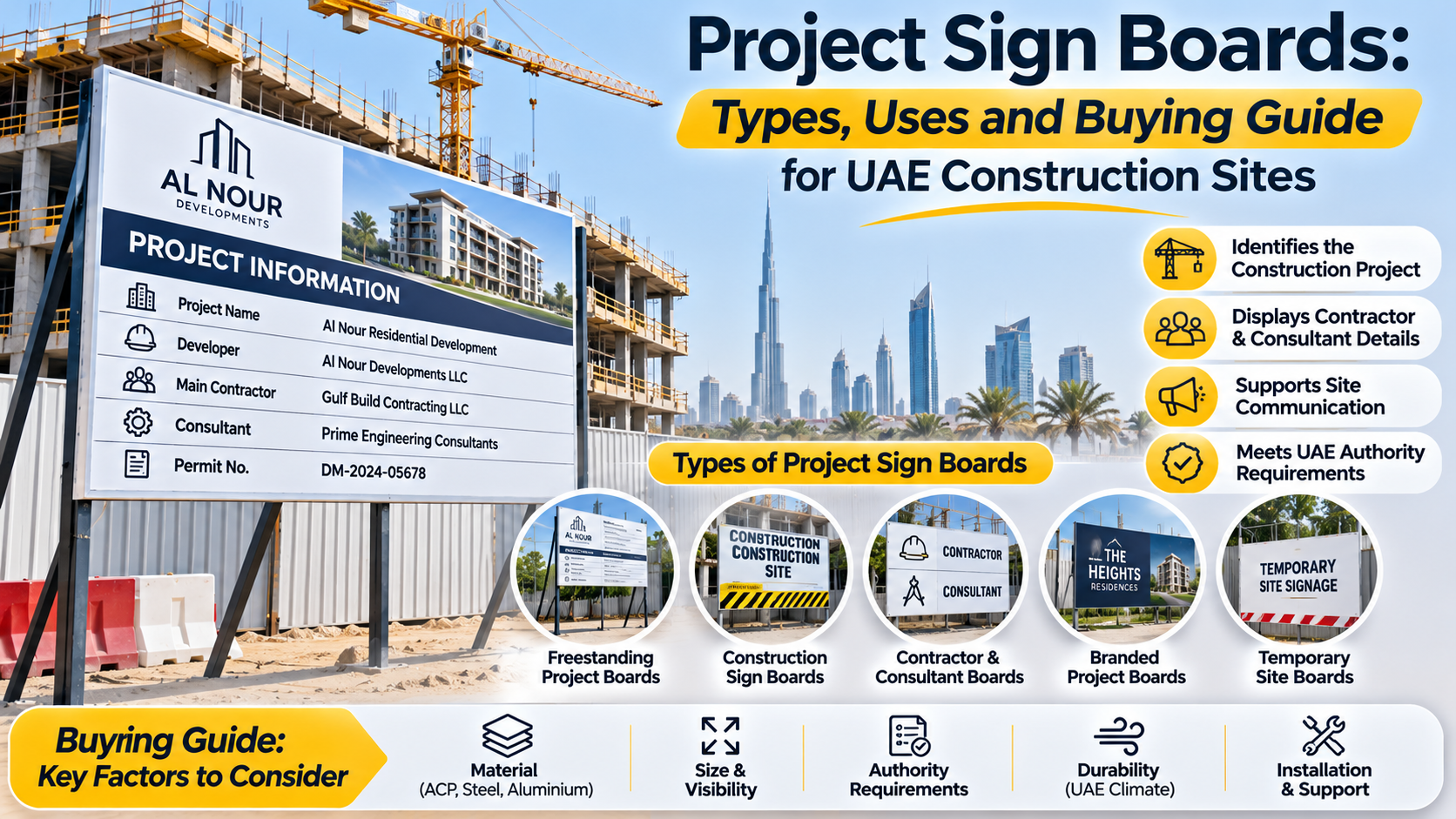
Construction projects need clear signage to communicate important information, identify responsible companies and help visitors recognise a development. Whether it is a residential building, commercial development or infrastructure project, the right project sign boards help present essential details in a professional and organised way.
For developers, contractors and consultants in the UAE, choosing suitable signage involves more than selecting a design. Material quality, board dimensions, outdoor durability, structural support and local authority requirements all need consideration.
This guide explains the different types of project sign boards, commonly used materials, important selection factors and what to check before ordering a construction sign board in the UAE.
What Are Project Sign Boards?
Project sign boards are information displays installed at construction sites, infrastructure developments and commercial building projects. They communicate essential details about a development and identify the organisations responsible for the work.
Depending on the project and applicable authority requirements, a project information board may display:
-
Project name and description.
-
Developer or property owner details.
-
Main contractor information.
-
Engineering consultant details.
-
Relevant permit or approval numbers.
-
Approved company logos and project branding.
-
Other information required by the relevant authority.
The exact content depends on the project location and type. For example, a residential development may require different information from an industrial facility or road construction project.
A well-planned board makes important project details easier to identify while maintaining a professional appearance.
Why Are Construction Project Sign Boards Important?
Construction sites involve multiple organisations, workers, visitors and other stakeholders. Clear signage helps communicate project information and supports better site identification.
Here are five important benefits.
1. Identifies the Construction Project
A clearly displayed project name helps visitors, nearby residents and other stakeholders recognise the development. It is particularly useful in areas where several construction projects are taking place simultaneously.
2. Displays Contractor and Consultant Information
Large developments may involve developers, engineering consultants, main contractors and subcontractors. Project signage provides a central place to display the required company details and identify the organisations involved.
3. Improves Site Communication
A properly organised information board allows visitors and authorised personnel to identify essential project details without relying entirely on verbal explanations.
4. Creates a Professional Project Image
Developers often want their projects to maintain a consistent visual identity. Professional signage can incorporate approved logos, brand colours and architectural graphics while keeping important information easy to read.
5. Supports Applicable Site Requirements
Certain authorities specify the information, dimensions, positioning and maintenance requirements for construction signage. Checking these requirements before manufacturing helps reduce the risk of corrections or replacement.
Different Types of Project Sign Boards
Not every construction site requires the same signage format. The appropriate design depends on the project size, site layout, viewing distance and information that needs to be displayed.
1. Freestanding Project Information Boards
<escape> </escape>
Freestanding boards are installed on supporting legs or a structural frame, generally near a construction site entrance or another visible location.
They are commonly considered for:
-
Residential building developments.
-
Commercial construction projects.
-
Infrastructure developments.
-
Industrial facilities.
-
Large development sites.
The supporting structure should be designed according to the board's dimensions, installation conditions and expected environmental loads.
2. Construction Sign Boards
Construction sign boards display project identification, company information, approved notices and other relevant details.
Their layouts should prioritise the information visitors need to recognise quickly. A typical design may include a printed panel, supporting frame and outdoor finishing.
The final specification should reflect the installation environment and any applicable authority guidelines.
3. Contractor and Consultant Information Boards
These boards focus on identifying the organisations involved in a development. Depending on project requirements, they may display company names, logos, contact details and relevant licence information.
For projects involving multiple organisations, the design should provide sufficient space for every required entry without making the information difficult to read.
4. Branded Project Display Boards
Developers may also use project signage to introduce a development visually. These displays can feature architectural images, project descriptions, development branding and other approved graphics.
The design should balance appearance with readability. Decorative elements should not distract from essential project information.
5. Temporary Construction Site Boards
Temporary boards are used when information needs to be displayed for a limited period or updated during different construction phases.
Before selecting one, consider how long it will be required, whether its information may change and how easily it can be removed or replaced.
Important: Project information boards are different from construction safety signs. Safety signs communicate hazards, mandatory actions, restrictions and emergency instructions. A large project display should not replace the safety signage required at specific locations around a construction site.
Which Materials Are Suitable for Outdoor Project Signage?
Material selection affects the appearance, weight, maintenance requirements and outdoor performance of a sign board.
In the UAE, construction signage may be exposed to strong sunlight, high temperatures, dust and wind. These conditions should be considered when selecting panels, printing methods and supporting structures.
Here are some commonly used materials.
Aluminium Composite Panel (ACP)
ACP consists of aluminium sheets bonded to a core material. It is commonly used for printed signage because it provides a relatively lightweight and flat surface.
Its potential advantages include:
-
Smooth surface for printed graphics.
-
Professional appearance.
-
Relatively lightweight construction.
-
Availability in different panel sizes.
-
Compatibility with different finishes.
The panel thickness and specification should be selected according to the intended application and installation requirements.
Galvanised Steel
Galvanised steel is commonly considered for supporting frames and structural components. Its zinc coating helps protect the steel against corrosion.
It may be used for:
-
Structural support frames.
-
Sign board legs.
-
Mounting components.
-
Outdoor signage supports.
The steel thickness, connection details and protective finish should be appropriate for the board's size and installation conditions.
Aluminium
Aluminium can be used for sign panels, frames and supporting components. Its relatively low weight makes it useful for applications where a lighter structure is preferred.
However, the correct section size, connections and fixing arrangements still need consideration, particularly for larger outdoor displays.
Printed Vinyl and Flex
Printed vinyl and flex materials are used for graphics and selected signage applications. Their suitability depends on the printing method, surface preparation, finishing and expected outdoor exposure.
Before selecting these materials, ask the supplier about:
-
UV resistance.
-
Print durability.
-
Surface finishing.
-
Cleaning requirements.
-
Expected performance in outdoor conditions.
The right material combination depends on the board's intended use, dimensions and installation environment.
How to Choose the Right Project Sign Board
A design that looks attractive on a computer screen may not perform effectively once installed at a construction site.
Before approving a project sign board, consider the following factors.
1. Assess the Viewing Distance
A board positioned beside a busy road needs a different layout from a smaller display inside a construction compound.
Consider:
-
How far away visitors will stand.
-
Whether vehicles approach from one or both directions.
-
Whether fencing, trees or temporary structures could obstruct the view.
-
Whether the information needs to be read while approaching the entrance.
Text should be large enough to remain legible from the intended viewing distance.
2. Organise the Information Clearly
Avoid giving every detail the same visual importance. The project name should be easy to identify, followed by contractor, consultant and permit information.
Use clear headings, suitable spacing and strong contrast between text and background.
If the board needs both Arabic and English information, plan the layout for both languages before production. This helps avoid overcrowding and unnecessary design changes later.
3. Select Suitable Dimensions
There is no single size that suits every construction project. Required dimensions can depend on the site, authority guidelines, viewing distance and amount of information.
Before confirming the size, check:
-
Available installation space.
-
Board width and height.
-
Required text size.
-
Visibility from the site entrance.
-
Structural support requirements.
-
Applicable authority specifications.
Do not assume that commonly used supplier dimensions will automatically meet the requirements of your particular project.
4. Check the Supporting Structure
The printed panel is only one part of a complete signage installation. The supporting frame, legs, base plates, connections and foundations also need attention.
Large outdoor boards can experience significant wind loading. Ask the supplier or responsible engineer to confirm that the proposed support arrangement is suitable for the installation conditions.
5. Consider Printing Quality and Finishing
Strong sunlight and environmental exposure can gradually affect printed colours and graphics. Dust can also reduce the appearance of an outdoor display.
Ask about UV-resistant printing, protective finishes and suitable cleaning methods. Reviewing a sample or final artwork proof before production can help identify design and colour issues.
Construction Sign Board Requirements in the UAE
Construction signage requirements can vary between emirates, development zones and individual authorities. A layout accepted for one location should not automatically be assumed suitable for another.
For example, Dubai Municipality Circular No. 11-1-1 of 2021 addresses project information and details signs. It also refers to the municipality's approved logo, safety instruction signage at construction site entrances, adequate lighting and maintenance to keep signs clear and readable.
Dubai Development Authority Circular 331 provides separate guidance for signboards and hoarding within its jurisdiction, including requirements relating to structural support and specified project information.
These examples demonstrate why contractors should check the requirements that apply to their particular site before manufacturing a board.
Before placing an order, confirm:
-
Which authority governs the construction site?
-
Is a specific sign board format or layout required?
-
What project and company information must be displayed?
-
Are particular dimensions, colours or logos specified?
-
Where should the board be installed?
-
Are structural drawings or approvals required?
-
Is lighting or regular maintenance necessary?
The project consultant or appointed contractor should verify the current requirements with the relevant authority. A signage supplier can assist with fabrication specifications, but the project team remains responsible for confirming regulatory compliance.
Common Mistakes to Avoid When Ordering Project Sign Boards
A few planning mistakes can lead to additional printing costs, installation delays or boards that need to be redesigned.
Using Text That Is Too Small
Trying to fit too much information onto a limited surface can make a board difficult to read.
Prioritise the required details, use a clear layout and maintain suitable text sizes rather than reducing every heading and paragraph to fit.
Ignoring Wind Exposure
Large outdoor boards need appropriately designed support structures. Selecting a frame based only on appearance can create installation and structural problems.
Discuss the board's dimensions, location and support requirements with the responsible supplier or engineer.
Approving Artwork Without Checking Details
Incorrect project names, company information, permit numbers or logos may require the board to be reprinted.
Always review the final artwork and obtain approval from the responsible project representative before production.
Choosing Materials Only on Initial Price
A cheaper panel or finish may not provide the performance needed for its installation environment.
Compare material specifications, printing quality, structural support and maintenance requirements instead of making a decision based on price alone.
Installing the Board in the Wrong Position
A professionally manufactured board can still be ineffective if it is hidden behind fencing, trees or site equipment.
Confirm the installation position before fabrication and ensure it meets applicable site and authority requirements.
How Are Project Sign Boards Manufactured and Installed?
A structured production process helps reduce errors and ensures the finished display matches the approved requirements.
Step 1: Requirement Assessment
The supplier reviews the project location, board dimensions, information requirements, material preferences and installation conditions.
Step 2: Artwork and Design Approval
The artwork is prepared using the project details, approved logos, company branding and required information.
The responsible project representative should check all details before production begins.
Step 3: Material Selection and Fabrication
The panel and supporting structure are prepared according to the agreed specification. Printing, cutting, finishing and frame fabrication are completed as required.
Step 4: Quality Inspection
The completed board should be checked for:
-
Correct project and company information.
-
Print clarity and colour consistency.
-
Agreed dimensions.
-
Surface condition and finishing.
-
Structural components and connections.
Step 5: Delivery and Installation
The board is delivered and installed at the approved location using the specified support and fixing arrangements.
Any required lighting, access arrangements or foundation work should be coordinated with the project team.
Where to Get Project Sign Boards in the UAE
Choosing a signage supplier involves more than finding a company that can print a large board. You also need to consider material options, fabrication capabilities, structural support and installation arrangements.
Vertex Fence provides project sign boards for construction sites, infrastructure developments, commercial projects and industrial facilities across the UAE.
Its listed signage solutions include ACP panels, galvanised steel support structures, UV-resistant printing, reflective finishes and custom dimensions. Optional installation support is also available, depending on project requirements.
If you are planning signage for a construction development, you can explore the Project Sign Boards by Vertex Fence and discuss your required dimensions, artwork, materials and installation arrangements before confirming an order.
Frequently Asked Questions
1. What information should be displayed on project sign boards?
The required information depends on the project location and applicable authority guidelines. Common details include the project name, developer, main contractor, consultant and permit number. Always confirm the mandatory information before preparing the artwork.
2. What is the best material for an outdoor construction sign board?
ACP is a commonly used option for printed outdoor panels, while galvanised steel is often used for supporting structures. The suitable combination depends on board dimensions, wind exposure, installation method and required finish.
3. How do I decide the correct size for a project sign board?
Consider the viewing distance, available installation area and amount of information that needs to be displayed. Then check the relevant authority's specifications. The final dimensions should allow readable text and appropriate structural support.
4. Are project information boards and construction safety signs the same?
No. Project information boards identify a development and display details about the project team. Safety signs communicate hazards, restrictions, mandatory actions and emergency information. Construction sites may require both types, positioned according to their separate purposes.
5. What should I ask a supplier before ordering project signage in the UAE?
Ask about panel materials, printing methods, custom dimensions, structural support, outdoor finishes, delivery, installation and maintenance. Also confirm whether the supplier can work from authority-approved artwork and technical specifications.
Conclusion
Project sign boards are an important part of construction site identification and information display. Their effectiveness depends on more than the printed design. Material selection, text readability, dimensions, structural support and correct positioning all need attention.
For UAE construction projects, check the applicable authority requirements before manufacturing or installation. By choosing suitable materials and approving the complete specification, developers and contractors can create signage that communicates project information clearly and suits its outdoor environment.

 English
 French
 Spanish
 Portuguese
 Deutsch
 Turkish
 Dutch
 Italiano
 Russian
 Romaian
 Portuguese (Brazil)
 Greek