


What Should You Consider When Planning a Budget for Dubai Website Design?
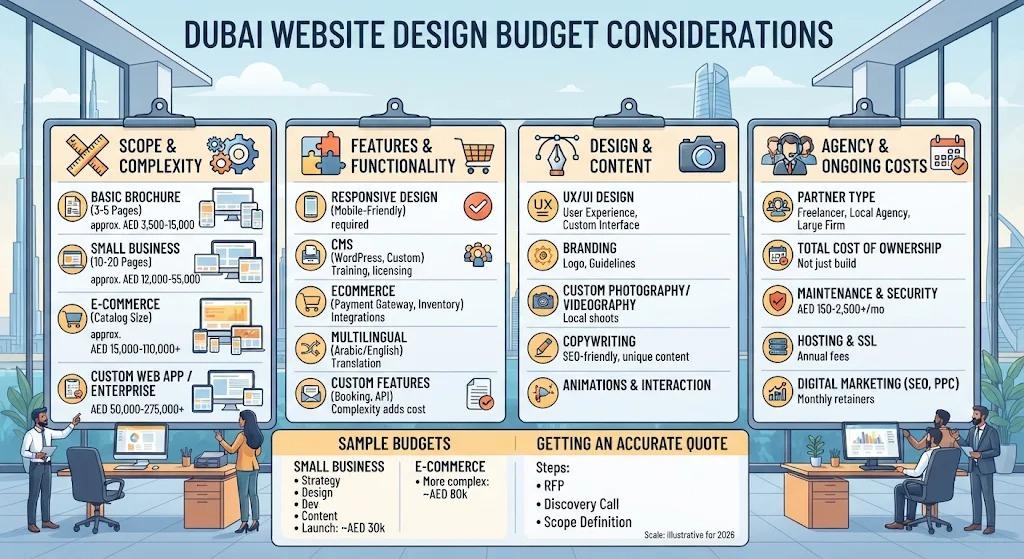
Dubai is one of the most competitive digital markets in the world. Customers there expect fast, polished, mobile-friendly websites, and many of them browse in both English and Arabic. A website is often the first impression a business makes, so the budget needs careful planning. Overspend and you cut into your marketing or operations. Underspend and you end up with a site that looks cheap, loads slowly, and fails to generate leads.
This guide covers the main factors to weigh when budgeting for a Dubai website design.
1. Understand Your Business Goals First
Define What the Website Must Achieve
Before asking for quotes, decide what the site is for. A brochure site that presents your company costs far less than an e-commerce store, a property portal, or a booking platform. Common goals include:
- Generating leads and inquiries
- Selling products or services online
- Building brand credibility
- Supporting a local SEO strategy
Match the Budget to the Goal
A clear goal prevents paying for features you will never use. A consultancy needs a clean, trustworthy site with strong contact forms. A retailer needs a secure checkout and inventory tools.
2. Know the Type of Website You Need
Corporate and Informational Websites
These typically have 5 to 15 pages: home, about, services, blog, and contact. They sit at the lower end of the price range.
E-Commerce Websites
Online stores require product catalogues, payment gateways, shipping logic, and security layers. Expect a noticeably higher investment, especially if you need integrations with local payment providers and delivery partners.
Custom Web Applications and Portals
Real estate listing portals, booking engines, and customer dashboards need custom development. These are the most expensive option and are usually priced by project scope rather than by page.
3. Choose Between Template and Custom Design
Template-Based Design
Templates built on platforms like WordPress or Shopify are faster and cheaper. They suit startups and small businesses that need to launch quickly. The trade-off is limited uniqueness and sometimes slower performance if the template is bloated.
Fully Custom Design
A custom design is built around your brand, audience, and conversion goals. It costs more, but it often performs better and scales more easily. In a market like Dubai, where brands compete on perception, custom design can be a worthwhile investment, especially in luxury, real estate, hospitality, and finance.
4. Factor In Arabic and Multilingual Support
Why Bilingual Matters in the UAE
Many Dubai businesses serve English, Arabic, and sometimes Russian, Hindi, Urdu, or Chinese-speaking audiences. A bilingual site is more than translated text.
Hidden Costs of Right-to-Left (RTL) Design
Arabic requires mirrored layouts, different typography, and careful testing. Professional translation and RTL development add to the budget, so ask any agency whether their quote includes them.
5. Plan for Essential Features and Functionality
Features That Increase Cost
Each feature adds development time. Common items to price separately include:
- Online payments and multi-currency support
- Live chat and WhatsApp integration
- CRM and marketing automation connections
- Property search filters or booking calendars
- Membership areas and customer logins
- Advanced analytics and tracking
Prioritise Must-Haves Over Nice-to-Haves
List features in two groups: essential for launch, and possible for later. A phased approach lets you launch sooner and add features as revenue grows.
6. Include SEO and Performance in the Budget
Technical SEO Foundations
A beautiful site that nobody finds wastes money. Budget for clean code, fast load times, mobile optimisation, structured data, and a sensible URL structure from the start. Fixing these problems later usually costs more.
Content and Keyword Strategy
Search-friendly copy, service pages, and a blog all support organic traffic. If you target competitive Dubai keywords such as real estate, web design, or luxury services, include content creation and ongoing optimisation in your plan.
Core Web Vitals and Mobile Speed
Most UAE users browse on mobile. Slow pages lose visitors and rankings, so performance work is not optional.
7. Account for Legal, Security, and Compliance Needs
Data Protection and Privacy
The UAE has data protection requirements, and your site should include a clear privacy policy, cookie notice, and secure handling of customer information.
Security Essentials
Budget for an SSL certificate, firewall protection, regular backups, and malware monitoring. These are small costs compared with the damage of a hacked or compromised site.
8. Remember Ongoing Costs After Launch
The Annual Running Costs
The launch price is only part of the story. Recurring expenses include:
- Domain registration and renewals
- Web hosting (shared, VPS, or cloud)
- Software licences, plugins, and premium themes
- Maintenance, updates, and security patches
- Content updates and new pages
Support and Maintenance Packages
Many agencies offer monthly retainers for updates, backups, and technical support. A retainer is often cheaper than paying for emergency fixes.
9. Compare Freelancers, Agencies, and In-House Teams
Freelancers
Freelancers can be affordable and flexible, which suits small projects. The risks are limited capacity, inconsistent availability, and fewer services under one roof.
Web Design Agencies
Agencies provide a full team of designers, developers, SEO specialists, and project managers. Prices are higher, but you get accountability, process, and broader expertise. This is usually the best fit for businesses that need a reliable, scalable result.
In-House Teams
Hiring in-house makes sense only for companies with continuous development needs. Salaries, visas, and tools make this the most expensive route for a typical small or mid-sized business.
10. Compare Quotes Carefully
Look Beyond the Price
When comparing proposals, check what each one includes:
- Number of pages and design revisions
- Responsive and bilingual development
- SEO setup and content writing
- Testing, training, and launch support
- Post-launch warranty or support period
Beware of Unrealistically Low Quotes
A very cheap quote can hide extra charges, poor-quality code, or reused templates. Ask for portfolio examples, client references, and a clear scope document before signing.
11. Set a Realistic Timeline and Contingency
Time Affects Cost
Rushed projects usually cost more because they need extra resources. A typical business website takes several weeks, while complex platforms can take months.
Keep a Contingency Fund
Set aside around 10 to 20 percent of the budget for scope changes, additional features, or unexpected technical needs. Projects rarely go exactly as first planned.
12. Think About Return on Investment
Measure Value, Not Just Cost
A website should earn back its cost through leads, sales, or reduced marketing spend. Estimate what one new client or customer is worth to you, and calculate how many the site needs to attract to pay for itself.
Track Results After Launch
Use analytics, call tracking, and conversion reports to see what works. Ongoing improvements to design, content, and user experience often deliver better returns than a complete rebuild.
Final Thoughts
Budgeting for a Dubai website means looking at the whole picture: the type of site, design approach, bilingual needs, features, SEO, security, and ongoing maintenance. The cheapest option is rarely the best value, and the most expensive is not always necessary. Define your goals, prioritise your features, compare detailed proposals, and keep room for growth. A well-planned budget leads to a website that looks professional, ranks well, and keeps bringing in business long after launch.
 Dutch
 English
 Arabic
 French
 Spanish
 Portuguese
 Deutsch
 Turkish
 Italiano
 Russian
 Romaian
 Portuguese (Brazil)
 Greek